
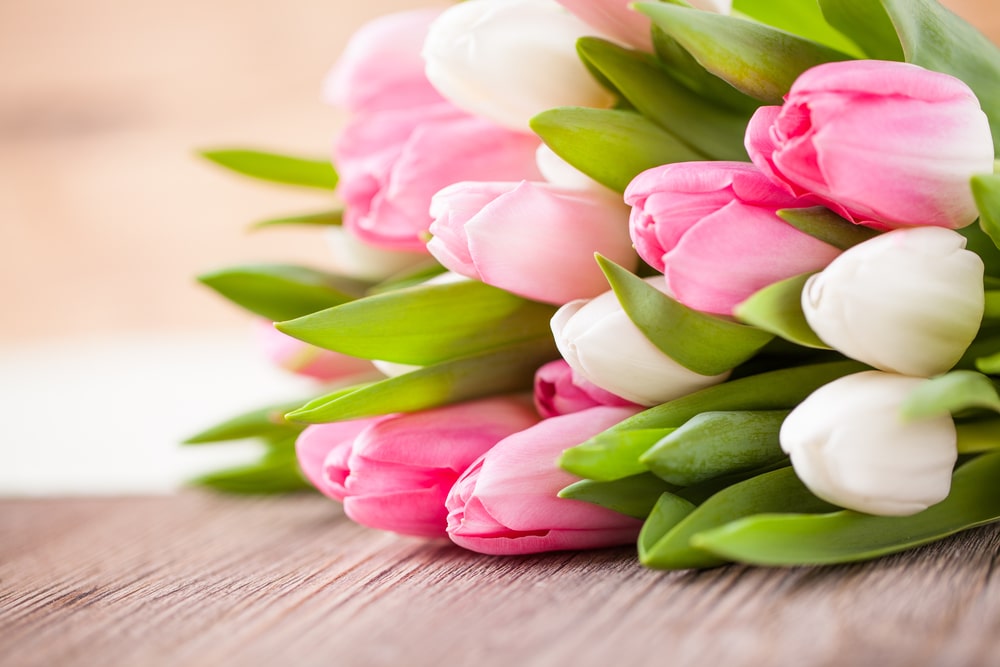
Everyone thinks of tulips and the Netherlands, but did you know tulips are actually native to the mountainous regions of Turkey and Russia? In the late 1500s, the Dutch got their first taste of tulips when the ambassador to Suleiman the Magnificent sent bulbs to a friend in Leiden, Holland. Europe, fresh out of the Dark Ages, fell in love with these vibrant flowers, sparking a craze known as Tulipomania, where bulbs sold for more than houses!
Today, the Netherlands grows and exports around 2 billion tulips a year, making it the world’s largest grower, but tulips still hold their exotic roots.
Grow Your Own Tulips
Speaking of growing tulips, here’s how to grow your own! Do not plant tulips until the soil has cooled off considerably—no sooner than the end of October up to mid-November here in Central Virginia.
Tulips are edible—meaning that if a squirrel, etc., can get to the bulb, they’ll eat it. But—there are things we can do! Plant tulip bulbs DEEP—10 inches deep. Squirrels will dig, but they do not tunnel. Plant them that deep, and the squirrels won’t get them. Because voles tend to tunnel in the top six inches where it’s easier to dig, they’ll miss them, too. This also serves to protect them a little from our summer heat. Remember, they’re native to the mountains, so they don’t mind the cold. It’s the summer heat they’re not fond of.
How to Repel Deer and Squirrels from Tulips
Now, I’m a lazy gardener—if I’m gonna dig a hole that deep, I’m going to make it “work” for me—I’ll tuck the tulips in the bottom, then cover them over to the six-inch depth. Then I’ll tuck daffodils or hyacinths in that layer. Then I’ll cover the daffs or hyacinths to the “tip” of the bulbs and set crocus or mini-iris, or muscari in that layer. Then I’ll cover those bulbs to the top of the hole. And just for looks, I’ll tuck a few pansies on top of the whole thing. That’s called “lasagna gardening”—planting in layers!
And, for those of us with deer (including me), putting daffodils or hyacinths in the middle layer will help to protect the tulips from them, too. See, daffodils are poisonous, and deer don’t like the smell or taste of hyacinths. They’ll smell those and leave the tulips alone.
And, just to keep the squirrels from nosing about the top layer, I’ll generously sprinkle crushed red pepper flakes over the whole area.
Keep Your Bulbs Happy
Another thing to ensure success: Tulips don’t like sleeping in a wet bed. When they’re dormant, they want to be dry. DON’T plant them in areas where you put fast-drying summer annuals that have to be watered every couple of days in the summer. Plant them in problem areas—on sunny slopes, along that back fence where the hose doesn’t reach.
The most important time to feed is in the fall when they’re “waking up” and growing roots for the winter. You can also feed them in the spring when the foliage first starts popping up. “Deadheading” (removing dead flowers) is also important so the bulb doesn’t expend energy trying to produce seeds.
Pick Up Your Bulbs at Meadows Farms
Visit us at The Great Big Greenhouse, located in Richmond, Virginia, for a stunning selection of tulips, daffodils, hyacinths, crocus, and more. Let us help you plan a beautiful spring garden that’s squirrel-proof, deer-resistant, and blooming with color!